JS Temporal Reference
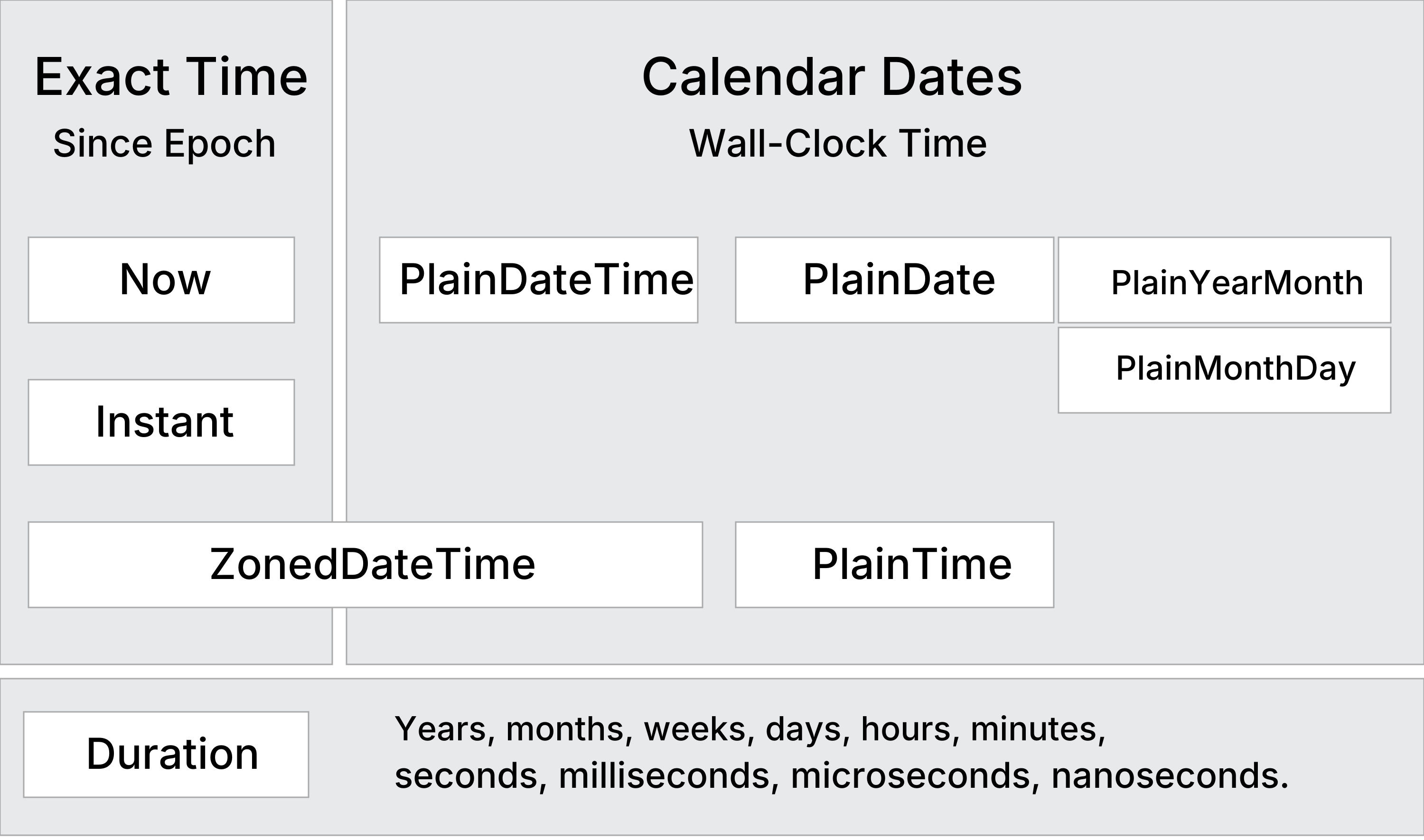
Temporal Objects
| Object | Description |
|---|---|
| Temporal.Duration | Length of time (e.g days, hours, minutes) |
| Temporal.Now | The current time |
| Temporal.Instant | A fixed point in time, independent of time zone |
| Temporal.ZonedDateTime | Date and time in a specific time zone |
| Plain Dates | |
| Temporal.PlainDate() | Calendar date only (2026-05-17) |
| Temporal.PlainTime() | Time of day only (14:30:00) |
| Temporal.PlainDateTime() | Full date and time (2026-05-17 14:30:00) |
| Temporal.PlainYearMonth() | Year and month only (2026-05) |
| Temporal.PlainMonthDay() | Month and day only (05-01) |
Temporal.Duration Methods
| Constructing | Description |
|---|---|
| from() | Returns a new duration object from an object or an ISO string |
| new() | Returns a new duration object from integer parameters |
| Arithmetic | |
| abs() | Returns a new duration with the absolute value of this duration |
| add() | Returns a new duration with a duration added to this duration |
| negated() | Returns a new duration with this duration negated |
| round() | Returns a new duration with this duration rounded |
| subtract() | Returns a new duration with a duration subtracted from this duration |
| Comparing | |
| compare() | Compares two durations (returning -1, 0, or 1) |
| Converting | |
| with() | Returns a new duration with specified field(s) modified |
| Formatting | |
| total() | Returns a number representing the duration in a given unit |
| toJSON() | Returns an RFC 9557 format string for JSON serialization |
| toLocaleString() | Returns a language-sensitive representation of the time |
| toString() | Returns an RFC 9557 format string representation |
| valueOf() | Throws a TypeError (prevents temporals from being converted to primitives) |
Temporal.Duration Properties
| Property | Description |
|---|---|
| blank | Boolean true if the duration represents a zero duration |
| days | Days as an integer (1-31) |
| hours | Hours as an integer (0-23) |
| microseconds | Microseconds as an integer (0-999) |
| milliseconds | Milliseconds as an integer (0-999) |
| minutes | Minutes as an integer (0-59) |
| months | Months as an integer (1-12) |
| nanoseconds | Nanoseconds as an integer (0-999) |
| seconds | Seconds as an integer (0-59) |
| sign | 1 positive -1 negative |
| weeks | Weeks as an integer |
| years | Years as an integer |
Learn More:
Temporal.Now Methods
| Method | Description |
|---|---|
| instant() | Returns current time as a Temporal.Instant object |
| plainDateISO() | Returns current date as a Temporal.PlainDate object |
| plainDateTimeISO() | Returns current date and time as a Temporal.PlainDateTime object |
| plainTimeISO() | Returns current time as a Temporal.PlainTime object |
| timeZoneId | Returns system's time zone as a time zone id |
| zonedDateTimeISO() | Returns current date and time as a Temporal.ZonedDateTime object |
Learn More:
Temporal.Instant Methods
| Constructing | Description |
|---|---|
| new | Creates a new Temporal.Instant object |
| from() | Creates a new Instant object from another instant or a string |
| fromEpochMilliseconds() | Returns a new Instant object from a number of milliseconds |
| fromEpochNanoseconds() | Returns a new Instant object from a number of nanoseconds |
| Arithmetic | |
| add() | Returns a new Instant with a duration added |
| round() | Returns a new Instant with this instant rounded |
| subtract() | Returns a new Instant with a duration subtracted |
| Comparing | |
| compare() | Returns -1, 0, or 1 from comparing two instants |
| equals() | Returns true if two instants are identical |
| since() | Returns the duration since another date |
| until() | Returns the duration until another date |
| Converting | |
| toZonedDateTimeISO() | Returns a new ZonedDatetime object |
| Formatting | |
| toJSON() | Returns an RFC 9557 format string for JSON serialization |
| toLocaleString() | Returns a language-sensitive representation of the instant |
| toString() | Returns an RFC 9557 format string representation of the instant |
| valueOf() | Throws a TypeError (Instants should not be converted to a primitives) |
Learn More:
Temporal ZonedDateTime Methods
| Constructing | Description |
|---|---|
| new | Creates a ZonedDateTime object |
| from() | Creates a ZonedDateTime object from an object or a string |
| Converting | |
| getTimeZone Transition() |
Returns a ZonedDateTime object representing the closest instant after or before this instant |
| toInstant() | Returns a Instant object representing this date-time |
| toPlainDate() | Returns a PlainDate object representing this date-time |
| toPlainDateTime() | Returns a PlainDateTime object representing this date-time |
| toPlainTime() | Returns a PlainTime object representing this date-time |
| startOfDay() | Returns a ZonedDateTime representing the first instant of this date |
| Updating | |
| with() | Returns a ZonedDateTime with specified fields modified |
| withCalendar() | Returns a ZonedDateTime with a different calendar system |
| withPlainTime() | Returns a ZonedDateTime the time part replaced by a new time |
| withTimeZone() | Returns a ZonedDateTime representing this date in a new time zone |
| Arithmetic | |
| add() | Returns a ZonedDateTime with a duration added |
| subtract() | Returns a ZonedDateTime with a duration subtracted |
| round() | Returns a ZonedDateTime rounded to a given unit |
| Comparing | |
| compare() | Returns -1, 0, or 1 from comparing two dates |
| equals() | Returns true if two ZonedDateTime objects are identical |
| since() | Returns the difference from another date |
| until() | Returns the difference until another date |
| Formatting | |
| toJSON() | Returns an ISO 8601 string for JSON serialization |
| toLocaleString() | Returns a language-sensitive representation of the date |
| toString() | Returns an ISO 8601 string representation |
| valueOf() | Throws a TypeError (prevents temporals from being converted to primitives) |
Temporal ZonedDateTime Properties
| Property | Description |
|---|---|
| calendarID | Calendar system identifier ("iso8601") |
| day | The day as an integer (1-31) |
| dayOfWeek | The day of the week as an integer (1 = Monday) |
| dayOfYear | The ordinal day of the year |
| daysInMonth | The total number of days in that month |
| daysInWeek | The total number of days in that week |
| daysInYear | The total number of days in that year |
| epochMilliseconds | Number of milliseconds since Unix epoch |
| epochNanoseconds | Number of nanoseconds since Unix epoch |
| era | The era name of the calendar, if applicable ("gregory") |
| eraYear | The year within the era, if applicable |
| hour | The hour as an integer (0-23) |
| hoursInDay | Hours in this day in this time zone(0-25) |
| inLeapYear | A boolean indicating if the date falls in a leap year |
| microsecond | The microsecond as an integer (0-999) |
| millisecond | The millisecond as an integer (0-999) |
| minute | The minute as an integer (0-59) |
| month | The month as an integer (1-12) |
| monthCode | A calendar-specific string code for the month ("M01") |
| monthsInYear | The total number of months in that year |
| nanosecond | The nanosecond as an integer (0-999) |
| offset | Offset used to interpret this instant (+HH:mm:ss.sssssssss) |
| offsetNanoseconds | Offset used to interpret this instant in nanoseconds |
| second | The second as an integer (0-59) |
| timeZoneId | Time zone identifier used to interpret this instant |
| weekOfYear | The week number within the year |
| year | The year as an integer |
| yearOfWeek | The year that the week belongs to |
Display All Properties
const zoned = Temporal.ZonedDateTime.from("2026-05-17T14:30:00[Europe/Oslo]");
Try it Yourself »
Learn More:
Temporal Plain Objects
| Object | Description |
|---|---|
| Temporal.PlainDate | Calendar date only (2026-05-21) |
| Temporal.PlainTime | Time of day only (14:30:00) |
| Temporal.PlainMonthDay | Month and day only (05-01) |
| Temporal.PlainYearMonth | Year and month only (2026-05) |
Temporal.PlainDate Methods
| Constructing | Description |
|---|---|
| from() | Creates a new PlainDate object from an object or a string |
| new | Creates a new PlainDate object from (year, month, day) |
| Arithmetic | |
| add() | Returns a new PlainDate with a duration added |
| subtract() | Returns a new PlainDate with a duration subtracted |
| Comparing | |
| compare() | Returns -1, 0, or 1 from comparing two dates |
| equals() | Returns true if two PlainDate objects are identical |
| since() | Returns the difference since another date |
| until() | Returns the difference until another date |
| Converting | |
| toPlainDateTime() | Returns a new PlainDateTime object |
| toPlainMonthDay() | Returns a new PlainMonthDay object |
| toPlainYearMonth() | Returns a new PlainYearMonth object |
| toZonedDateTime() | Returns a new ZonedDatetime object |
| with() | Returns a new PlainDate with specified fields modified |
| withCalendar() | Returns a new PlainDate with a different calendar system |
| Formatting | |
| toJSON() | Returns an RFC 9557 format string for JSON serialization |
| toLocaleString() | Returns a language-sensitive representation of the date |
| toString() | Returns an RFC 9557 format string representation |
| valueOf() | Throws a TypeError (should not be converted to primitives) |
Temporal.PlainDate Properties
| Property | Description |
|---|---|
| calendarID | Calendar system identifier ("iso8601") |
| day | The day as an integer (1-31) |
| dayOfWeek | The day of the week as an integer (1 = Monday) |
| dayOfYear | The ordinal day of the year |
| daysInMonth | The total number of days in that month |
| daysInWeek | The total number of days in that week |
| daysInYear | The total number of days in that year |
| era | The era name of the calendar, if applicable |
| eraYear | The year within the era, if applicable |
| inLeapYear | A boolean indicating if the year is a leap year |
| month | The month as an integer (1-12) |
| monthCode | A string code for the month ("M01") |
| monthsInYear | The total number of months in that year |
| weekOfYear | The week number within the year |
| year | The year as an integer |
| yearOfWeek | The year that the week belongs to |
Learn More:
Temporal.PlainYearMonth Methods
| Constructing | Description |
|---|---|
| from() | Creates a PlainYearMonth object from an object or a string |
| new (constructor) | Creates a PlainYearMonth object from integer parameters |
| Arithmetic | |
| add() | Returns a new PlainYearMonth with a duration added |
| subtract() | Returns a new PlainYearMonth with a duration subtracted |
| Comparing | |
| compare() | Returns -1, 0, or 1 from comparing two dates |
| equals() | Returns true if two dates are identical |
| since() | Returns the difference since another date |
| until() | Returns the difference until another date |
| Converting | |
| toPlainDate() | Returns a new PlainDate object |
| with() | Returns a new PlainYearMonth with fields modified |
| Formatting | |
| toJSON() | Returns an RFC 9557 format string for JSON serialization |
| toLocaleString() | Returns a language-sensitive representation of the date |
| toString() | Returns an RFC 9557 format string representation |
| valueOf() | TypeError (temporals cannot be converted to primitives) |
Temporal.PlainYearMonth Properties
| Property | Description |
|---|---|
| calendarID | Calendar system identifier ("iso8601") |
| daysInMonth | The total number of days in that month |
| daysInYear | The total number of days in that year |
| era | The era name of the calendar, if applicable ("gregory") |
| eraYear | The year within the era, if applicable |
| inLeapYear | A boolean indicating if the date falls in a leap year |
| month | The month as an integer (1-12) |
| monthCode | A calendar-specific string code for the month ("M01") |
| monthsInYear | The total number of months in that year |
| year | The year as an integer |
Learn More:
Temporal.PlainMonthDay Methods
| Constructing | Description |
|---|---|
| from() | Creates a PlainMonthDay object from an object or a string |
| new (constructor) | Creates a PlainMonthDay object from integer parameters |
| Comparing | |
| equals() | Returns true if two PlainMonthDay objects are identical |
| Converting | |
| toPlainDate() | Returns a new PlainDate object |
| with() | Returns a new PlainMonthDay with specified fields modified |
| Formatting | |
| toJSON() | Returns an RFC 9557 format string for JSON serialization |
| toLocaleString() | Returns a language-sensitive representation of the date |
| toString() | Returns an RFC 9557 format string representation of the date |
| valueOf() | TypeError (temporals cannot be converted to primitives) |
Temporal.PlainMonthDay Properties
| Property | Description |
|---|---|
| calendarID | Calendar system identifier ("iso8601") |
| day | The day as an integer (1-31) |
| monthCode | A calendar-specific string code for the month ("M01") |
Learn More:
Temporal PlainTime Methods
| Constructing | Description |
|---|---|
| from() | Creates a new PlainTime object from an object or a string |
| new | Creates a new PlainTime object from integer parameters |
| Arithmetic | |
| add() | Returns a new PlainTime with a duration added |
| subtract() | Returns a new PlainTime with a duration subtracted |
| round() | Returns a new PlainTime rounded to a given unit |
| Comparing | |
| compare() | Returns -1, 0, or 1 from comparing two times |
| equals() | Returns true if two PlainTime objects are identical |
| since() | Returns the difference since another time |
| until() | Returns the difference until another time |
| Modifying | |
| with() | Returns a new PlainTime with specified fields modified |
| Formatting | |
| toJSON() | Returns an RFC 9557 format string for JSON serialization |
| toLocaleString() | Returns a language-sensitive representation of the time |
| toString() | Returns an RFC 9557 format representation of the time |
| valueOf() | Throws a TypeError Prevents temporals from being converted to primitives |
Temporal.PlainTime Properties
| Property | Description |
|---|---|
| hour | The hour as an integer (0-23) |
| microsecond | The microsecond as an integer (0-999) |
| millisecond | The millisecond as an integer (0-999) |
| minute | The minute as an integer (0-59) |
| nanosecond | The nanosecond as an integer (0-999) |
| second | The second as an integer (0-59) |
Learn More:
Temporal.PlainDateTime Methods
| Constructing | Description |
|---|---|
| from() | Creates a PlainDateTime object from an object or a string |
| new | Creates a PlainDateTime object from parameters |
| Arithmetic | |
| add() | Returns a PlainDateTime with a duration added |
| subtract() | Returns a PlainDateTime with a duration subtracted |
| round() | Returns a PlainDateTime rounded to a given unit |
| Comparing | |
| compare() | Returns -1, 0, or 1 from comparing two dates |
| equals() | Returns true if two PlainDateTime objects are identical |
| since() | Returns the difference from another PlainDateTime |
| until() | Returns the difference until another PlainDateTime |
| Converting | |
| toPlainDate() | Returns a PlainDate object with the date from this PlainDateTime |
| toPlainTime() | Returns a PlainTime object with the time from this PlainDateTime |
| toZonedDateTime() | Returns a ZonedDatetime object with this PlainDateTime in a time zone |
| with() | Returns a PlainDateTime with specified fields modified |
| withCalendar() | Returns a PlainDateTime with a different calendar system |
| withPlainTime() | Returns a PlainDateTime with the time part replaced by a new time |
| Formatting | |
| toJSON() | Returns an RFC 9557 format string for JSON serialization |
| toLocaleString() | Returns a language-sensitive representation of the date |
| toString() | Returns an RFC 9557 format string representation of the date |
| valueOf() | Throws an error to prevents temporals from being converted to primitives |
Temporal.PlainDateTime Properties
| Property | Description |
|---|---|
| calendarID | Calendar system identifier ("iso8601") |
| day | The day as an integer (1-31) |
| dayOfWeek | The day of the week as an integer (1 = Monday) |
| dayOfYear | The ordinal day of the year |
| daysInMonth | The total number of days in that month |
| daysInWeek | The total number of days in that week |
| daysInYear | The total number of days in that year |
| era | The era name of the calendar, if applicable ("gregory") |
| eraYear | The year within the era, if applicable |
| hour | The hour as an integer (0-23 |
| inLeapYear | A boolean indicating if the date falls in a leap year |
| microsecond | The microsecond as an integer (0-999) |
| millisecond | The millisecond as an integer (0-999) |
| minute | The minute as an integer (0-59) |
| month | The month as an integer (1-12) |
| monthCode | A calendar-specific string code for the month ("M01") |
| monthsInYear | The total number of months in that year |
| nanosecond | The nanosecond as an integer (0-999) |
| second | The second as an integer (0-59) |
| weekOfYear | The week number within the year |
| year | The year as an integer |
| yearOfWeek | The year that the week belongs to |
Display All Properties
const date = new Temporal.PlainDateTime(2026, 5, 1, 14, 30);
Try it Yourself »
Learn More:
Temporal Arithmetic
| Method | Returns |
|---|---|
| temporal.add() | New temporal representing a date moved forward by a duration |
| temporal.subtract() | New temporal representing a date moved backward by a duration |
| temporal.round() | New temporal rounded down to specified unit |
Temporal Comparison
| Method | Description |
|---|---|
| temporal.compare() | Static method useful for sorting arrays of dates (returns -1, 0, or 1) |
| temporal.equals() | Returns true if two dates (and their calendars) are identical |
| temporal.since() | The duration between two temporal objects |
| temporal.until() | The duration between two temporal objects |

